St. Aegidien Church Oschatz


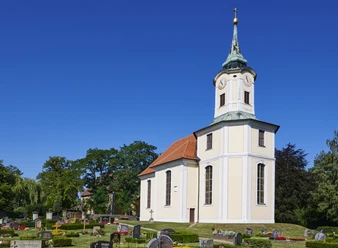
Following a town fire in 1842, which also destroyed the church, a three-aisled neo-Gothic hall church was built in 1846 - 1849, incorporating the previous Gothic building from 1443 - 1464. With its two 75-meter-high towers, the church is visible far into the countryside. The interior was designed by Carl Alexander von Heideloff. The altar he designed corresponds to the structure of a winged altar. Peter Vischer's figures from the tomb of St. Sebaldus in Nuremberg served as a model for the design of the pulpit with its carved figures of the twelve apostles. The Jehmlich organ from 1851/1933 is located on the two-storey west gallery. Carl Alexander von Heideloff was also involved in the façade design.
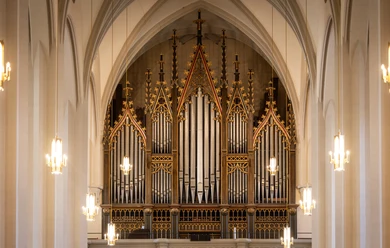
Carl Gottlieb Jehmlich (1786 - 1867) & Söhne, Zwickau, built the organ with mechanical action and slider windchests in 1851 after six previous instruments. II/44 There is evidence of organs in St. Aegidien since 1495. In 1933, a tonal and technical rebuild and the addition of a third manual took place. III/56 A new console with the manual ranges of C - a''', the pedal range of C - f ' and electro-pneumatic control document the technical status of this era. When renovation work began in the church in 2002, the organ was first encased and then restored from 2003 to 2005 by the organ workshop Christian Scheffler, Sieversdorf, according to the construction concept from 1933.
Texts: Klaus Gernhardt
Carl Gottlieb Jehmlich (1786 - 1867) & Söhne, Zwickau, built the organ with mechanical action and slider windchests in 1851 after six previous instruments. II/44 There is evidence of organs in St. Aegidien since 1495. In 1933, a tonal and technical rebuild and the addition of a third manual took place. III/56 A new console with the manual ranges of C - a''', the pedal range of C - f ' and electro-pneumatic control document the technical status of this era. When renovation work began in the church in 2002, the organ was first encased and then restored from 2003 to 2005 by the organ workshop Christian Scheffler, Sieversdorf, according to the construction concept from 1933.
Texts: Klaus Gernhardt
Good to know
Accessibility
- Saxony Barrier-FreeNotes on accessibility / deviations from the pictograms:
- Access to the church via 1 step á 5 cm inside and door >90 cm.
- The nave is barrier-free accessible
- Hearing loop for the hearing impaired, extra entrance via ramp on the south side.
Directions & Parking facilities
- By public transport: From Leipzig main station, take the RE50 to Oschatz. In Oschatz, change to bus 801 to Oschatz, Dippoldisplatz. It is about 290 m on foot to the destination.
By car: Follow the A14 to S38 in Grimma, take exit 32-Mutzschen on the A14. Follow the S38, take Oschatzer Str. and Wermsdorfer Str. to Kirchpl. in Oschatz. Organization
Leipzig Tourismus und Marketing GmbH
License (master data)
Leipzig Tourismus und Marketing GmbH