Stemweder Berge - Rundwanderweg "Rote Linie"

- 0:53 h
- 2.65 km
- 112 m
- 109 m
- 75 m
- 192 m
- 117 m
- Start: Freudeneck parking lot
- Destination: Freudeneck parking lot
A public motorhome parking area is located at the starting point. For those passing through, this is a nice stopover to stretch your legs and shop at the nearby fruit grower.
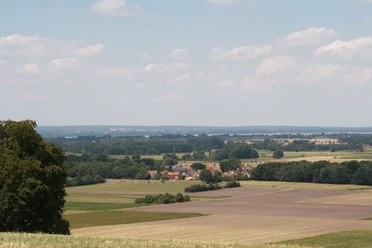
The Stemweder Berg is located in the south-east of the Dümmer Nature Park. At 181 meters above sea level, it is the last elevation before the North German Plain. To the south is the park-like cultural landscape of the municipality of Stemwede. To the east of Lake Dümmer is the Oppenweher Moor. The Stemweder Berg consists of limestone from the late Cretaceous period. This soft limestone contains imprints of shells, but also whole shells, and various fossils are exhibited in the Dümmer Museum in Lembruch. There are two large stands of the extremely rare woodruff beech forest here. Various historical boundary stones can be discovered in Stemweder Berg. As a result of the Peace of Westphalia in 1648, Minden and thus the southern part of the Stemweder Berg became part of Brandenburg (Prussia). High-trunk orchards on the edge of the Stemweder Berg provide a habitat for dormice, little owls and various species of bat. Water seeps away quickly in the glacial dry valleys of the Stemweder Berg. Shallow ponds are only present in small areas. In addition to native game such as roe deer, hare, pheasant and fox, the great spotted woodpecker and black woodpecker can also be found. Cowslip, arum, lily of the valley, native orchids and woodruff are also present. This extensive forest area is accessible via well-developed and marked hiking trails of varying lengths, each of which starts at a hiking parking lot. The information boards set up there and the hiking map provide information and help with orientation. All routes are also suitable for walking or jogging.
The Stemweder Berg is located in the south-east of the Dümmer Nature Park. At 181 meters above sea level, it is the last elevation before the North German Plain. To the south is the park-like cultural landscape of the municipality of Stemwede. To the east of Lake Dümmer is the Oppenweher Moor. The Stemweder Berg consists of limestone from the late Cretaceous period. This soft limestone contains imprints of shells, but also whole shells, and various fossils are exhibited in the Dümmer Museum in Lembruch. There are two large stands of the extremely rare woodruff beech forest here. Various historical boundary stones can be discovered in Stemweder Berg. As a result of the Peace of Westphalia in 1648, Minden and thus the southern part of the Stemweder Berg became part of Brandenburg (Prussia). High-trunk orchards on the edge of the Stemweder Berg provide a habitat for dormice, little owls and various species of bat. Water seeps away quickly in the glacial dry valleys of the Stemweder Berg. Shallow ponds are only present in small areas. In addition to native game such as roe deer, hare, pheasant and fox, the great spotted woodpecker and black woodpecker can also be found. Cowslip, arum, lily of the valley, native orchids and woodruff are also present. This extensive forest area is accessible via well-developed and marked hiking trails of varying lengths, each of which starts at a hiking parking lot. The information boards set up there and the hiking map provide information and help with orientation. All routes are also suitable for walking or jogging.
Good to know
Best to visit
- suitableDepends on weather
Tour information
Familiy-Friendly
Loop Road
Loop Road
Author
Organization
Tourist Information Dümmerland
License (master data)
Tourist Information Dümmerland

Nearby
Download GPX file