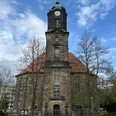
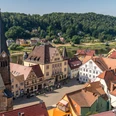
The town church of St. Marien in Pirna is not only one of the most important sacred buildings in Saxony, but also an important cultural center for Pirna, which attracts visitors from near and far with its musical highlights, as well as international artists.
St. Marien was designed by the master builder Peter Ulrich, who lived nearby on the market in the Peter-Ulrich-Haus, today's Tom-Pauls-Theater. Peter Ulrich is also the master builder of the famous Annenkirche in Annaberg-Buchholz. Both church buildings are the most important hall churches in Upper Saxony, demonstrating the European status of late Gothic architecture in Saxony.
The roof truss of St. Mary's Church in Pirna has a baroque tower dome, which has had the only seven-part peal of bells in the Saxon state church since 1994.
Until the 20th century. The bells were operated by hand by a bell ringer who lived above them.
The Marienkirche organ was built in 1842 by Friedrich Nikolaus Jahn (Dresden).
The Marienkirche Pirna has been included in the federal government's "Nationally Valuable Cultural Monuments" preservation program.
With around 120 members, the Kantorei St. Marien is one of the largest choirs in Saxony. With its long tradition, it is of outstanding importance for the culture of the region.
The four annual oratorio concerts of the choir form the center of the rich concert life in St. Marien.
The Elblandphilharmonie Sachsen is a constant and reliable musical partner for these concert performances. Every year, the Christmas vespers at Christmas time and the traditional tower blowing attract many visitors from beyond the region to St. Mary's Church in Pirna.
The St. Mary's choir is also involved in extensive musical work with children and young people. When the choir and youth choir take part in church services and concerts, all generations can experience lively music-making.
St. Marien was designed by the master builder Peter Ulrich, who lived nearby on the market in the Peter-Ulrich-Haus, today's Tom-Pauls-Theater. Peter Ulrich is also the master builder of the famous Annenkirche in Annaberg-Buchholz. Both church buildings are the most important hall churches in Upper Saxony, demonstrating the European status of late Gothic architecture in Saxony.
The roof truss of St. Mary's Church in Pirna has a baroque tower dome, which has had the only seven-part peal of bells in the Saxon state church since 1994.
Until the 20th century. The bells were operated by hand by a bell ringer who lived above them.
The Marienkirche organ was built in 1842 by Friedrich Nikolaus Jahn (Dresden).
The Marienkirche Pirna has been included in the federal government's "Nationally Valuable Cultural Monuments" preservation program.
With around 120 members, the Kantorei St. Marien is one of the largest choirs in Saxony. With its long tradition, it is of outstanding importance for the culture of the region.
The four annual oratorio concerts of the choir form the center of the rich concert life in St. Marien.
The Elblandphilharmonie Sachsen is a constant and reliable musical partner for these concert performances. Every year, the Christmas vespers at Christmas time and the traditional tower blowing attract many visitors from beyond the region to St. Mary's Church in Pirna.
The St. Mary's choir is also involved in extensive musical work with children and young people. When the choir and youth choir take part in church services and concerts, all generations can experience lively music-making.
Good to know
Openings
May to October
Monday - Saturday 11:00 - 17:00
Sunday 15:00 - 17:00
November to April
Monday - Saturday 11:00 - 15:00
Sunday 14:00 - 16:00
Public holiday day off
Monday - Saturday 11:00 - 17:00
Sunday 15:00 - 17:00
November to April
Monday - Saturday 11:00 - 15:00
Sunday 14:00 - 16:00
Public holiday day off
Dayoff: Closed all holidays
General information
Parking Available
Bus stop available
Eligibility
Suitable for any weather
for Groups
Payment methods
Entrance Free
Accessibility
Saxony Barrier-Free
Notes on accessibility / deviations from the pictograms:
- Access via 1 step of 5 cm and door 103 cm
- The nave is barrier-free, the altar area accessible by prior arrangement
- Special guided tours for the blind and wheelchair users are possible by prior arrangement
- An induction loop is available
- Public, barrier-free toilet on the market square, approx. 100 m away from the church
Directions & Parking facilities
Easily accessible by public transport.
various bus lines and S-Bahn
Bus stop: ZOB / Pirna train station
Walking distance: approx. 15 min.
various bus lines and S-Bahn
Bus stop: ZOB / Pirna train station
Walking distance: approx. 15 min.
Author
Tourismusverband Sächsische Schweiz e.V.
Mandy Krebs
Organization
Tourismusverband Sächsische Schweiz e.V.
License (master data)
Mandy Krebs Tourismusverband Sächsische Schweiz e.V.

Nearby