Experience route Seelitz - On the Trail of Porphyry


- 3:45 h
- 13.63 km
- 160 m
- 153 m
- 154 m
- 253 m
- 99 m
- Start: Mühlplatz Rochlitz
- Destination: Mühlplatz Rochlitz
Rochlitz porphyry was and is a supplier for millstones, murder and atonement crosses, post columns, signposts, boundary stones, window and door frames, or bridges, of which numerous contemporary witnesses can still be discovered today. The experience route Seelitz extends approximately 13 kilometers through the southern area of the municipality of Seelitz and the southwestern part of the large district town of Rochlitz.
The start and end point for the circular route is the Mühlplatz in Rochlitz. However, entry to the route is also possible at any other point. Its course through the idyllic landscape of the Rochlitz Mulde valley combines architectural art with the beauty of nature.
Waypoints
Good to know
Pavements
- Unknown (6%)Street (3%)Asphalt (46%)Gravel (27%)Trail (4%)Path (14%)
Best to visit
- suitableDepends on weather
Directions
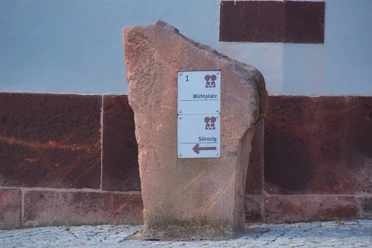
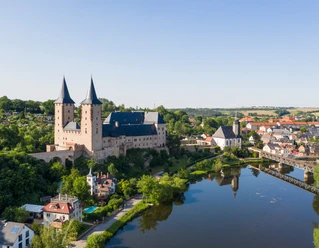
The experience route starts at the Mühlplatz in Rochlitz with the "Gerichtsschänke", the Villa Haberkorn where Albrecht Haberkorn, the last quarry owner of the Haberkorn family, lived until his death in 1948, and the Schlossmühle, whose water power is now only used to generate electricity. Not far away are the oldest church in the Rochlitz area, St. Peter's Church, and Rochlitz Castle with its two mighty towers, the Jupen. Below the castle, the Sörnzig path leads the Mulde upstream from Rochlitz to Sörnzig – past a picturesque villa, the "Old Bark Mill".
Next stops are the "Schlossaue" and the exhibition grounds of the Rochlitz and surrounding area Rabbit Breeders Association, the German Shepherd Dog Association, and the Endurance Sports Club Rochlitz Mountain. To the right, the Stonecutter Walk branches off from the experience route. It is a connection to the Rudolf-Zimmermann-Weg, which leads to the Rochlitz Mountain with its porphyry educational trail. A little further straight ahead, the path leads through the Mordgrund, named after the game animals commonly called "Mard" in the local dialect. Shortly before the end of the forest, on the right side, stands the Katzenstein, a solitary granite rock, not far from which is the so-called Trumpeter's Leap. A fleeing rider is said to have once fallen to his death here.
In Sörnzig itself, the experience route passes the country inn. Before the route continues over the striking Sörnzig suspension bridge, it is worth walking a few meters straight ahead – to a beautiful farm with numerous porphyry details.
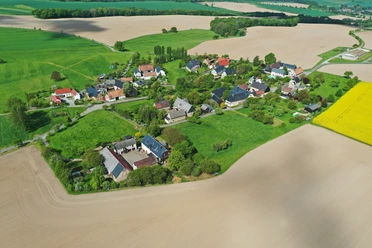
After Fischheim, where the path passes a farmstead richly decorated with porphyry, the experience route leads through the idyllic landscape of the Rochlitz Mulde valley, past numerous viewpoints offering a magnificent view over the surrounding towns, continuing to Beedeln. The village, almost completely preserved in its original circular layout, has been carefully restored. The entire village is now under monument protection and attracts special attention. Beedeln hosts the oldest barn in Saxony. Another attraction is the Hahn holiday farm.
North of Beedeln lies the small village of Seebitzschen, whose oldest building from 1576 is located on a four-sided farmstead, notable for its yard gateway that passes directly through another building, making it a special visual attraction.
Next is the small village of Zöllnitz, where a few years ago the Kunsthof Zöllnitz, a place for all art enthusiasts, was established. A little off the experience route is the Zöllnitz mill, which is still in very good condition today.
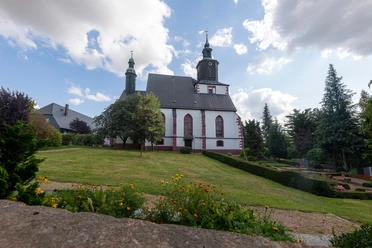
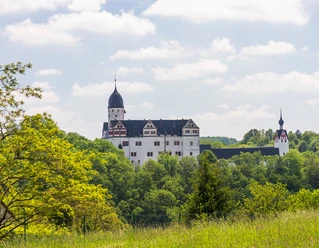
Along the bank of the Erlbach, the route continues to Seelitz. An important village experience area is the riding stable of the Seelitz Riding and Driving Club. The former pilgrimage church Seelitz, located on a hill and visible from afar, is a stately late Gothic building and, alongside Rochlitz's St. Peter's Church, the oldest church in the Mittweida district. The historic parish complex is enriched by the parsonage, the substitute house, and the former parish school. Furthermore, the Seelitz school is among the oldest in the Rochlitz region. Historical sources document that educational opportunities existed in Seelitz as early as 1527.
Continuing back towards Rochlitz, the route leads past Biesern, whose beautiful landscape with its hiking trails invites you to long walks – for example, past the former sand pit where a lake with a water surface of 16 hectares was formed.
The last stop is the Rochlitz district Zaßnitz with its suspension bridge. It offers a unique view of Rochlitz Castle and St. Peter's Church.
Tour information
Loop Road
Stop at an Inn
Equipment
Sturdy footwear, weather-appropriate clothing, and provisions
Directions & Parking facilities
- Getting there
A4 exit Chemnitz-East, then continue via B107 to Rochlitz
A14 exit Döbeln-North, then continue via B169 and B175 to Rochlitz
A72 exit Rochlitz, continue via B175 to Rochlitz
ParkingFree parking "An der Bleiche" Uferstraße Rochlitz
Public transportationStarting point Rochlitz:
By train to Burgstädt and then further by bus to Rochlitz
or
By train to Geithain and then further by bus to Rochlitz
- Bus 628, 629: Geithain - Rochlitz
- Bus 626: Burgstädt - Rochlitz (stop Rathausstraße)
Author
Verena Daser
Organization
LEIPZIG REGION
License (master data)
Verena Daser

Author´s Tip / Recommendation of the author
- St. Peter's Church with Schmeisser organ
- Rochlitz Castle
- Forest adventure trail (Wechselburg Station 8)
- Fischheim playground
Nearby


Download GPX file